
Expect to Land a Role within 8 - 9 Months
LinkedIn envy will tell you that Breaking into Product Management is an overnight success. Great for clicks, terrible for your mental health.
If you have zero knowledge, expect to land a role in 6–12 months. However, if you possess transferable skills, relevant knowledge, or a strong drive, landing a position in about 8 to 9 months is not uncommon.
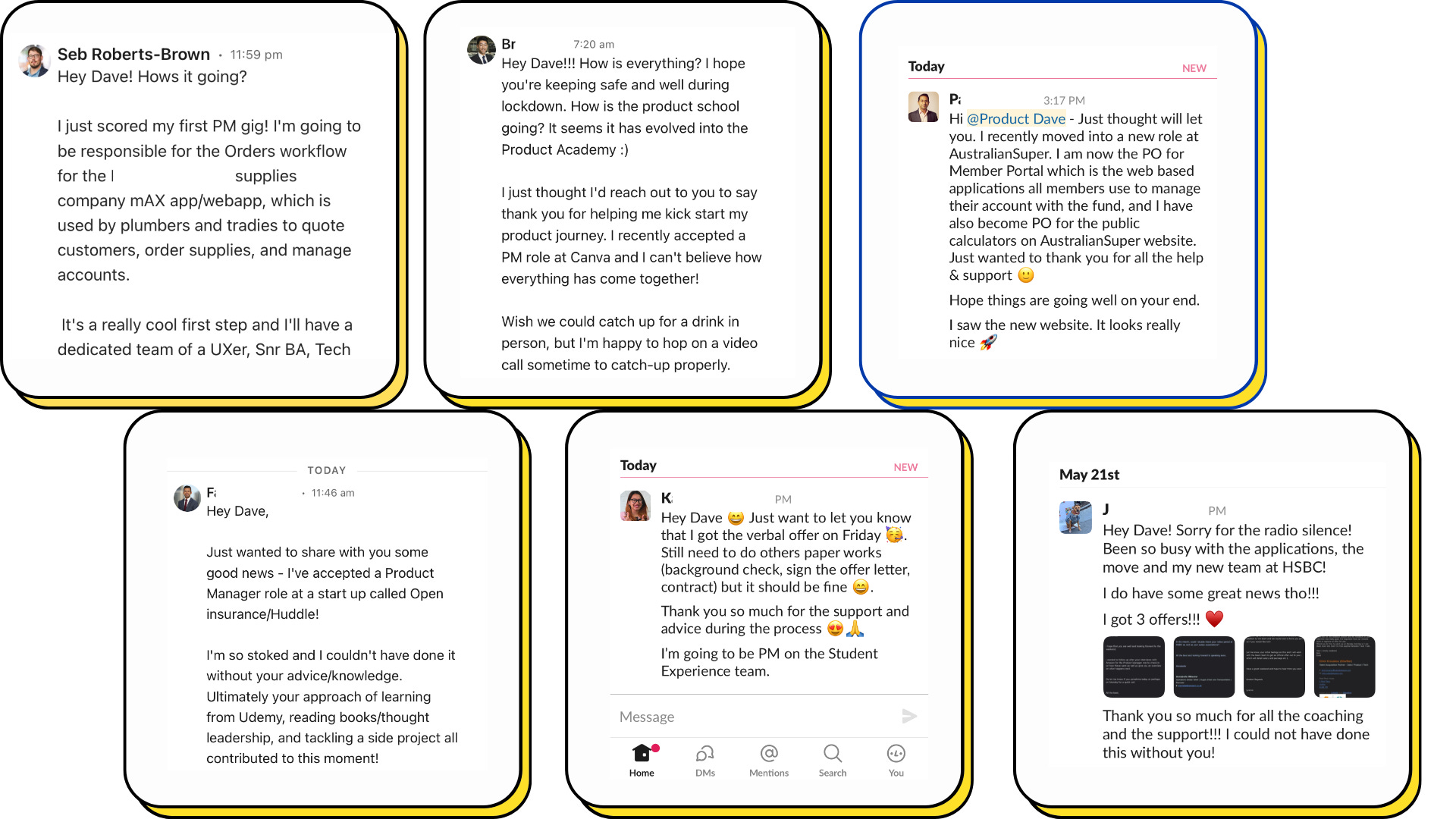
To put this in perspective, this makes up less than 5% of your time in a 20-year Product Management career. With a base salary ranging from $120K to $300K, your invested time can provide massive returns.
Here are the 5 Phases you’ll go through:

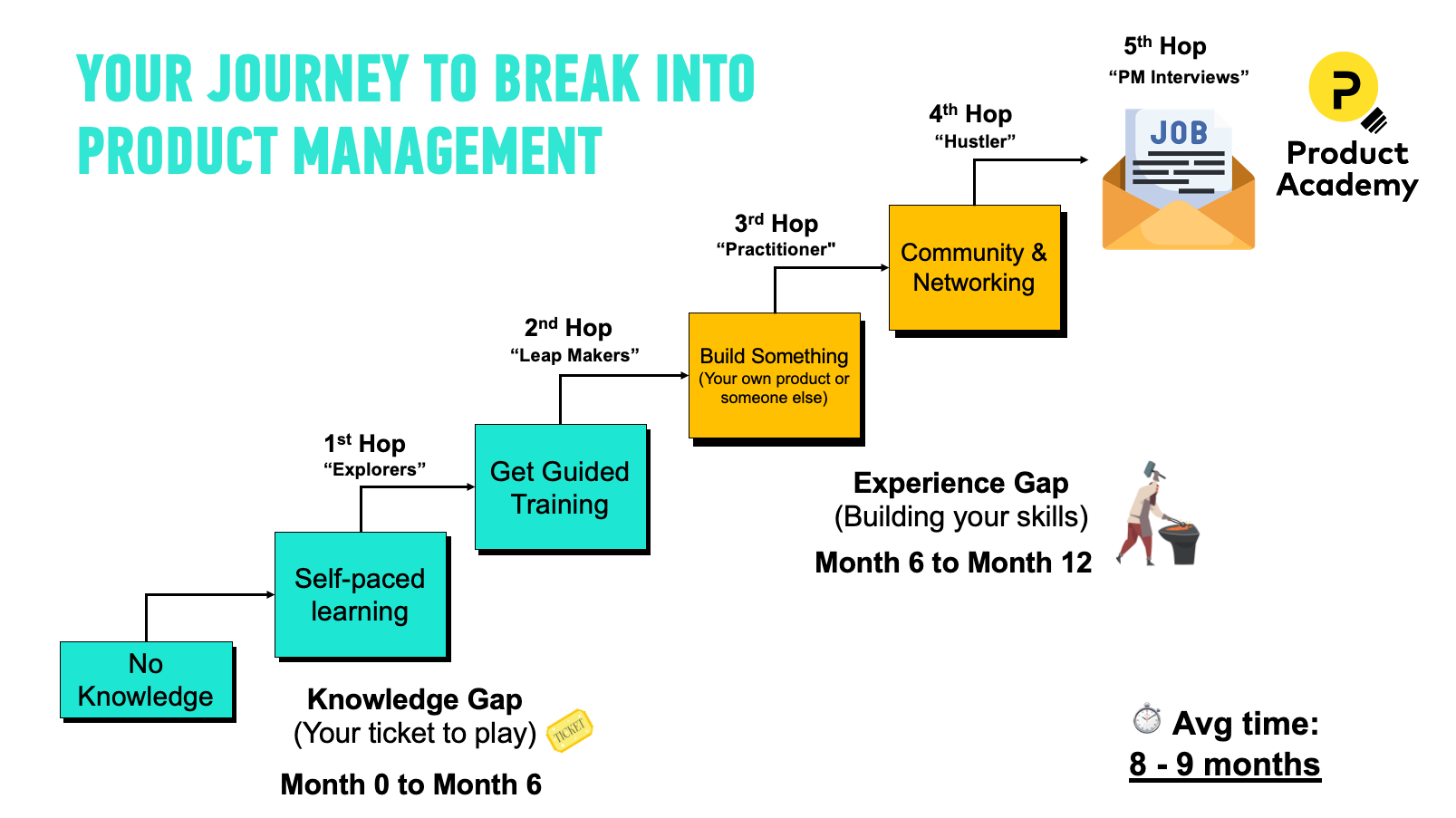
Phase #1: Build Knowledge Without Breaking the Bank (Months 1 - 3)
Product Managers dedicate a significant part of their time to making high-leveraged decisions. Each path they choose to take is choosing which path to avoid. The first step in becoming a PM is understanding this mindset.
Firstly, Treat yourself as a Product
You shouldn’t try to learn everything simultaneously but choose the right learning course for your Product Lifecycle. Early on, it’s about small investments - like building an MVP.

You need to test if your skills are what the market needs. If not, what do you need to build? A common mistake I see many people make is spending thousands at this stage, thinking the money spent will save them time. However, understanding if PM is the right role for you is a decision that can be validated within a $30 book, not a $5K course.
First 3 Months → Read Books and Self-Paced Courses
Start with a budget ranging from $100 to $500 over three months. Dive into essential PM literature to grasp the fundamentals. There are lots of books out there, so it can be overwhelming. I’d suggest to start with these three first to help you understand key concepts and jargon:
-
Escaping the Build Trap: How Effective Product Management Creates Real Value
-
What Colour is Your Parachute (this is not a PM book but helps with career transitions)
Avoid self-published books for now. It might be accurate, and you’re too early in your journey to spot the difference. Like learning a sport, changing bad habits is hard. Stick to trusted, vetted resources at this stage.
Find Affordable Self-Paced Courses
At the same time, start with self-paced courses. These courses provide engaging learning through visual slides and dedicated focus. Courses also include templates and resources for applying product thinking in your professional work.
Most self-paced courses start at around $30; anything over $600 is not worth the ROI. Unlike writing a book where it goes through peer reviews, anyone can create an online course nowadays. You want to ensure the instructor is CREDIBLE.
This means:
-
They’re a current or recent Senior Product Manager or higher (within the past 5 years). Product Management is constantly evolving, and anyone who hasn’t been in the industry for 5+ years is likely out of touch. (That is why I decided to return to working and not starting a consulting company) You don’t want to learn from second-hand sources—always go straight to the source.
-
FREE courses on YouTube or similar platforms are snacks, not main courses. With only 3 - 4 hours a week for a course, prioritise the highest ROI for your time. Snack on YouTube courses during the break.
-
Avoid training that teaches you a “Process” or “Framework”. E.g. SAFe Process, Agile Process, Scrum Process, Design Sprint Process, or any free training sponsored by a company. These trainings are designed for existing Product Managers later in the track but not for you now. You need to learn the Mindsets first, then the Process, then the Tools.

With so many courses available, it can be overwhelming. Here are a few courses I’ve tested; consider them benchmarks as you explore other options:
The first 1 - 3 months is a litmus test. If motivation is low, step away and find your calling. If you’re grinding now, you’ll grind later. We vote with our time on the things we care about.
Phase #2: Use Formal Training To Build a Support Party (Months 4 - 6)
By Month 4, You should have learnt the jargon and mindsets to jam with other PMs or aspiring PMs. It’s time to join a structured program to get guided support, network and create a support system for your journey.
Your goal in this phase is to build a group of 5 or 6 aspiring PMs so you can support each other on the journey. At the same time, network with a few industry Product Managers so you can tap into them for advice.
The best way to do this is to join a formal course and training led by a practising Product Manager.
It’s Not the Brand, it’s the Instructors
There’s no shortage of educational institutions offering courses right now. The key isn’t the brand—it’s the instructors.
Most institutions provide their instructors with frameworks and materials, but the value lies in separating what works in practice.
An experienced PM has the insight to help you choose one framework or over another, what you can get away with in your Resume vs what you can’t.
The best part? Connecting with a practising PM gives you direct insight into what PM companies seek and how teams operate. Unlike consultants or agile coaches, who may focus on general frameworks or general career advice.

A working PM is your best bet if you’re looking for industry connections and up-to-date, practical advice.
Budget Between $2K to $5K for a Product Management Bootcamp
Let’s me real: Learning Product Management is not the same as getting an MBA. Anything over $5K typically isn’t worth the ROI.
Focus on BootCamp programs that run 5 to 10 weeks—anything shorter won’t give you the depth you need to learn Product Management. Anything longer will turn you into a hermit crab. 🐚
With so many courses available, it can be overwhelming. Here are a few that I either teach or have come across with decent reputations—use them as benchmarks as you explore other options:
-
Product School SF (I dislike the Certificate selling, but they attract some good instructors)
Take the time to research each course to ensure it aligns with your timeline, goals and learning style. The best course is the one that fits your needs, not just the one with the most buzz. If you need guidance, reach out to me on Linkedin.
Phase #3: Gain Hands-On Experience (6-12 Months)
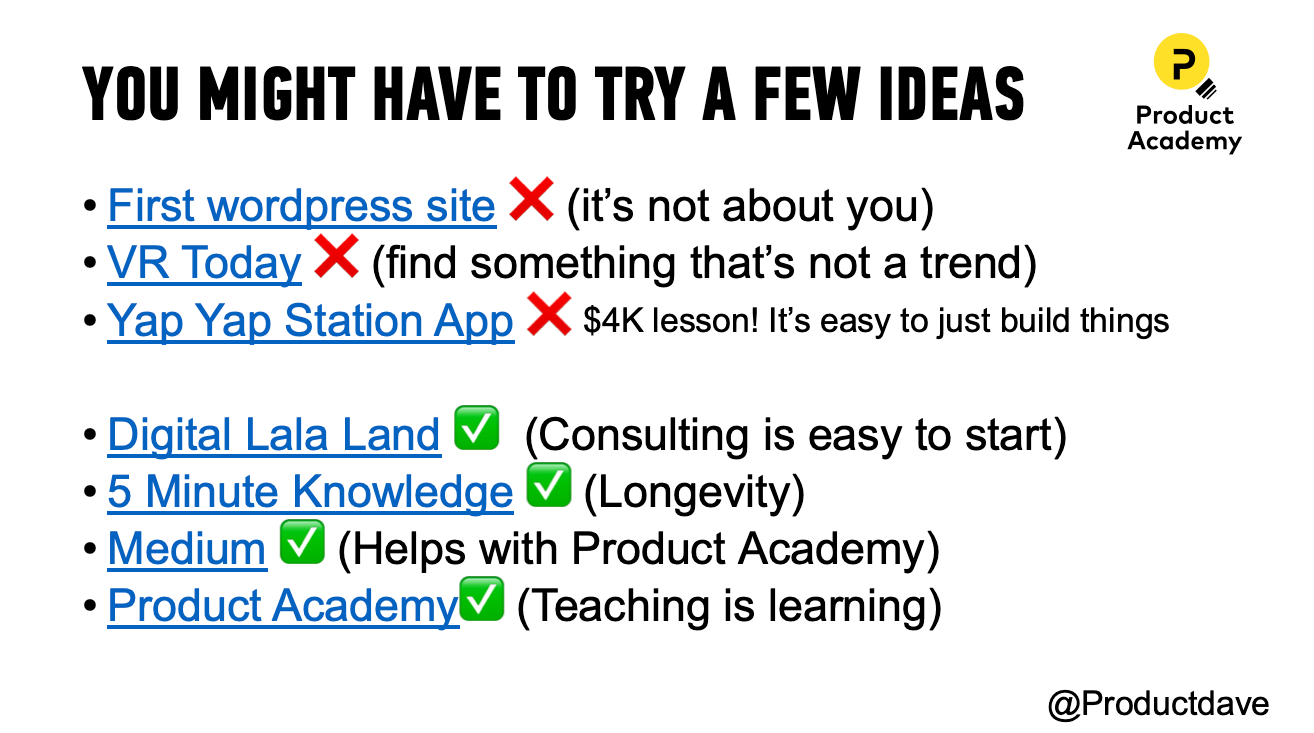
You’ve likely gone through a few books and self-paced courses and created a support group via formal training by this stage. It’s time to build something by yourself.
Thanks to AI, it’s now easier than ever to build side projects
I’ve never met a Product Manager who doesn’t have ideas for a business or a side hustle. It’s like an unspoken secret in the industry. Side projects are great for networking and building your Product Manager brand.
Your side project differs from the capstone projects you built in your PM training Bootcamps, although you can still use the same idea. This is building it with actual designers and developers.

I will write a more detailed guide on building side projects, but for now, let’s touch on this area a bit:
-
Get Ideas: Sign up for podcasts, newsletters, and blogs about building side hustles. Here are some podcasts I listen to get you started: My First Million, How I Built This, and Side Hustle Podcast, Ask ChatGPT for Business Ideas, and here are 200+ AI Startup ideas
-
Build products, not services: Build a Content Product, an E-commerce Product, or a Software Product. Avoid hospitality businesses, franchises, or anything that requires full-time to run.
-
Use AI for research: Use Google Gemini or ChatGPT to do Deep Research on Market Dynamics
-
Use AI to Build: Build AI Prototypes with UX Pilot and Figma AI, outsource development work to Upwork or Freelancer.com
-
Market it: Launch via LinkedIn and Meetup groups, tap into existing Marketplaces, and use Paid Ads if needed.
-
Iterate, Iterate, Iterate
This stage may require you to invest additional time and money
Set a budget of 5% of a PM salary on this - depending on your local market, this investment may vary. Take an example of the US: $120K Average salary x 4% = $4,800
Then, divide the budget into three iterations.
For each iteration, spend roughly around $500 on Design, $500 on Development, and $500 on Marketing. ($1500 Total). You’ll need around 2 to 3 iterations to get the right product. (Total around $4,500 across 3 - 4 months)
At the same time, don't mismanage your budget and overspend—this isn’t about building a startup but learning and gaining experience.
Don’t outsource thinking about the Product Strategy and the MVP; only outsource execution. If something is too good to be true, chances are it is. If Amazon could start with $10K, you can too.
Be careful of Excuses That Keep You Comfortable in Mediocrity.
Here, you’ll realise that our brains will make up a lot of excuses: I don’t have the money, I don’t have time, I’m busy at work, I have kids, etc. You’re shifting the responsibility of your career to others.
If you want to feel better, blame others. If you want to be outstanding, blame yourself. To be an outstanding PM candidate, you need to stand out from the crowd. That’s the definition of outstanding. 😄
Phase #4: Network using your Side Project
The side hustle is not just a resume booster; it’s a tool to connect with mentors, peers, PMs and hiring managers. Highlight your side project is used for product experience so recruiters recognise it’s not your full-time job.
Hiring managers often ask their peers for referrals, and recruiters collaborate closely with hiring managers to find the right candidates. I frequently get DMs about candidate referrals, and I love asking other product leaders for their suggestions. Referrals save time for everyone involved, so you need to make yourself “referrable”.

Make Yourself Referrable: Define Your PM / Market Fit
Networking starts with knowing what you want before asking for help. People are willing to help, but they put their reputations on the line for you.
When a recruiter or hiring manager is looking for an aspiring Product Manager in Fintech with experience in Payments, you want to be top of mind.
Start by understanding what you want and devising a strategy for yourself. One key tool I love is a Mnookin 2-Pager from Phyl Terry. It’s a great tool that helps you determine your desired industry, work, culture, and essential ‘must-nots’.
Once you know what you don’t want, you can focus your time on what you want. This is my 2-Pager for your reference:
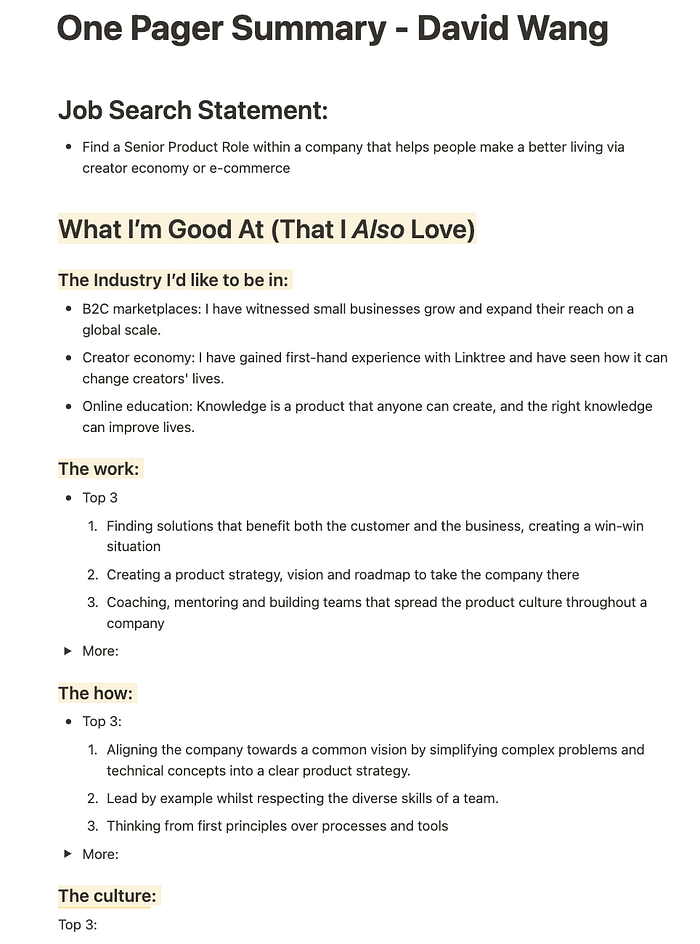
When networking, you want people to remember you for the expertise you’ve outlined in your 2-pager. A generic “Generalist PM” approach won’t cut it—especially early in your career. You likely don’t have the broad industry experience to make that positioning work.
Instead, start as a specialist in a specific domain or skill set, then expand your scope over time. Build depth first, then go wide.
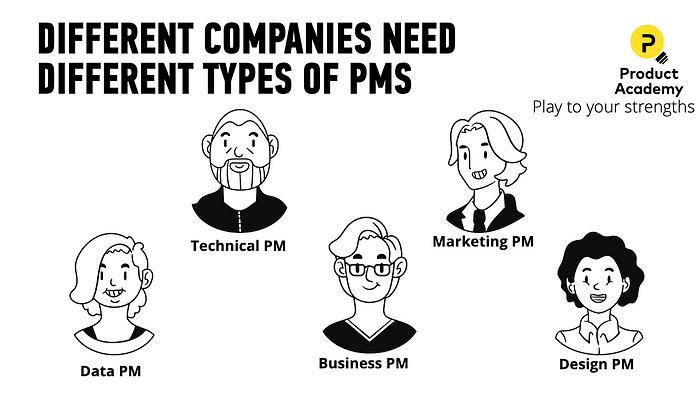
There is a lot for me to write here, and I’ve skipped a lot of topics related to resume writing, networking channels, keeping track of relationships, cold outreach, follow-ups and juggling with your current job. I will follow up with more posts about these topics in the future:
In the meantime - read Phyl Terry’s book Never Search Alone; it’ll change your perspective on the job search.
Step 5: Compete for Product Management Roles
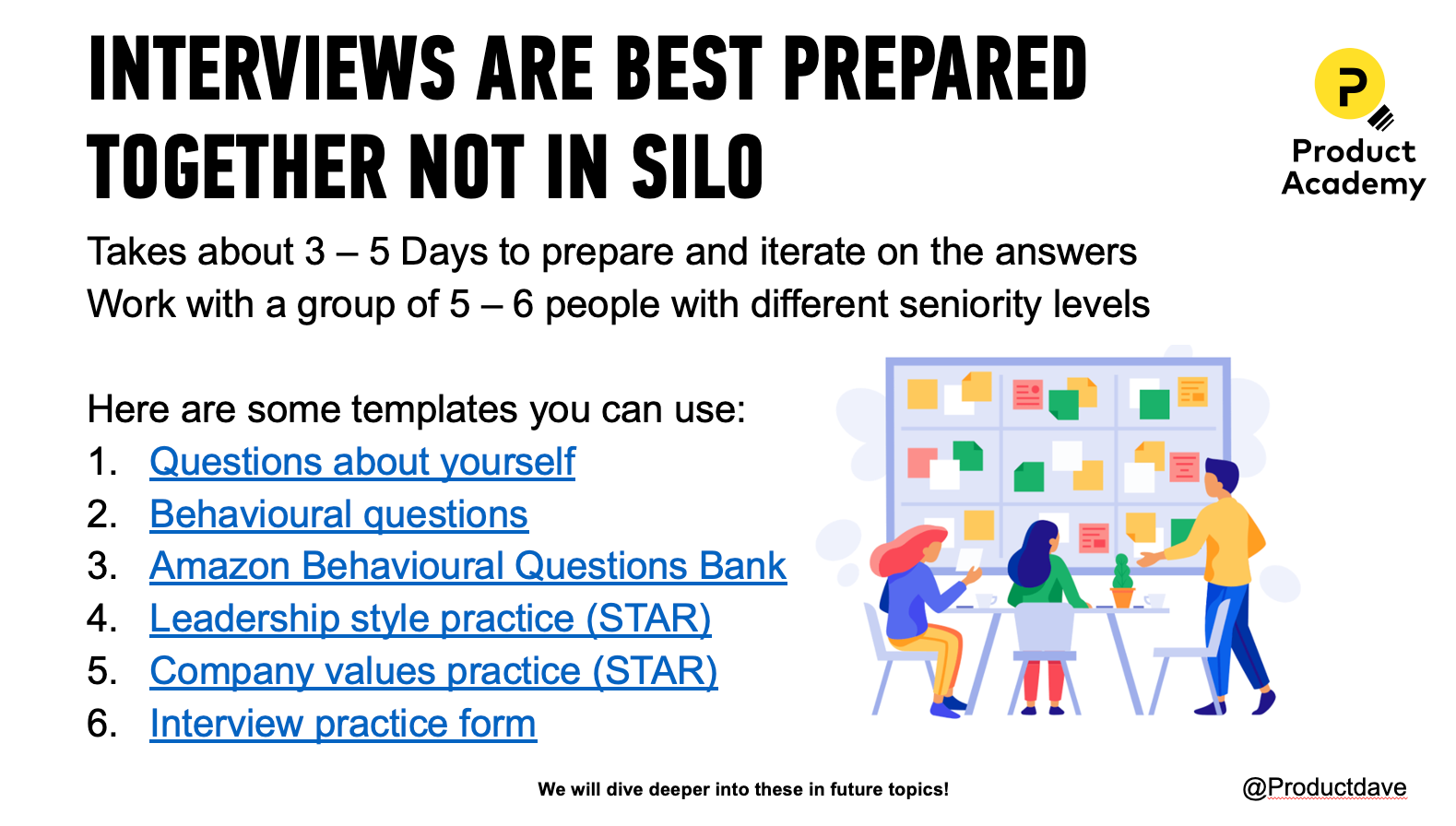
By now, you should have built an MVP of your side project, shared your learnings on LinkedIn, and actively networked with Product folks. This groundwork will lead to referrals and callbacks. When an opportunity arise, it’s time to prepare for interviews.
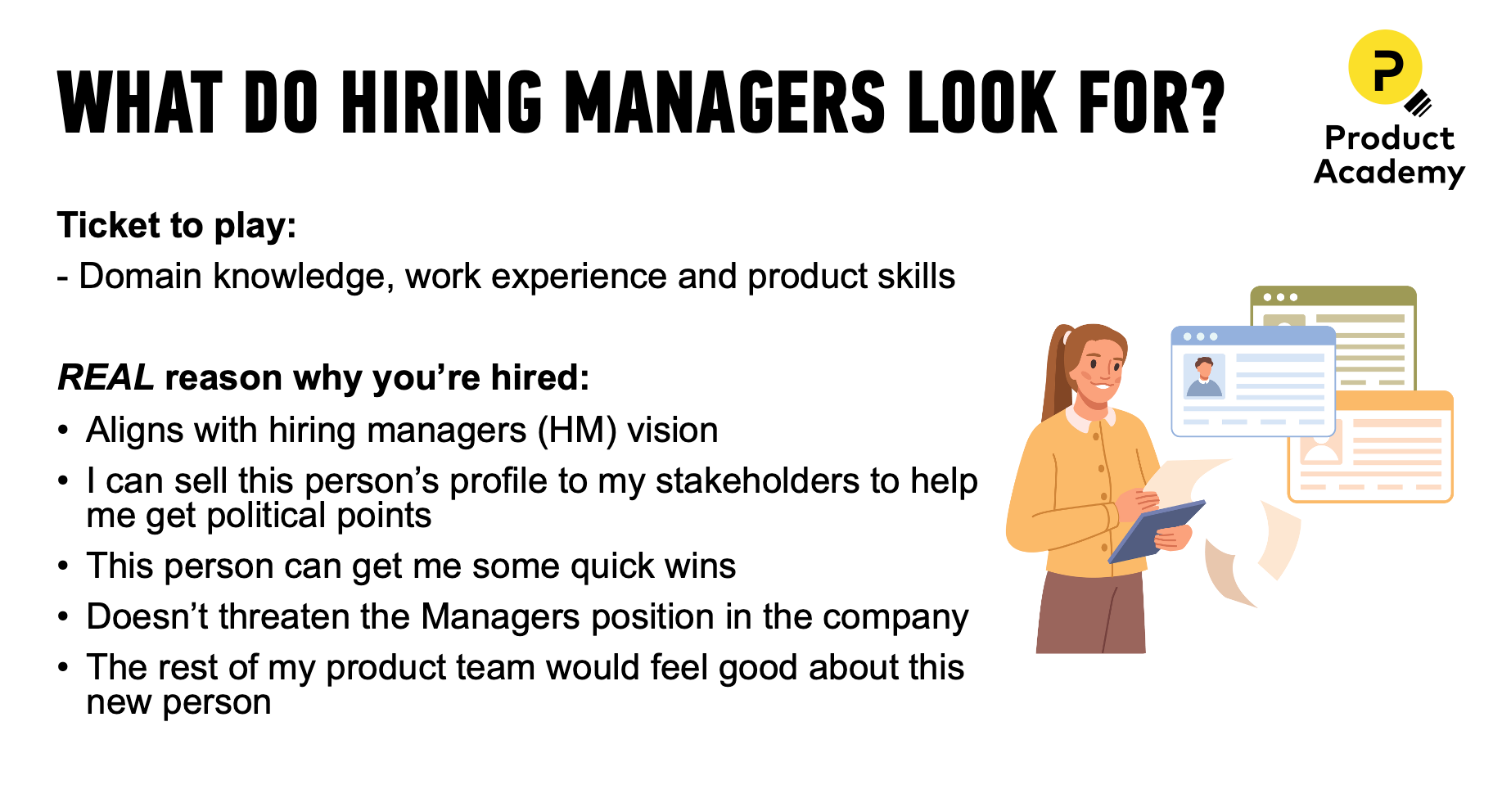
PM interviews are tough because they test theory and real-world experience—you need to show your product mindset and execution.
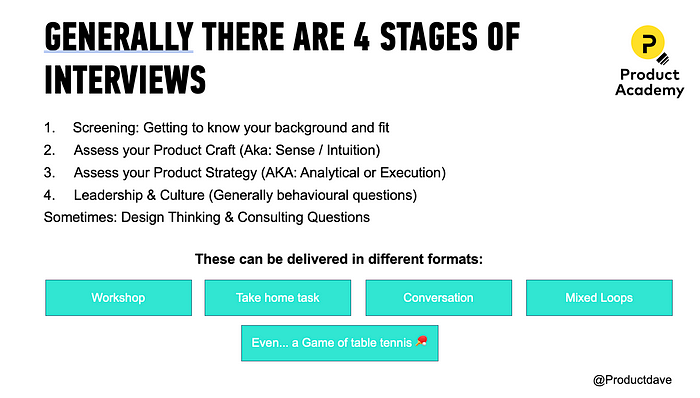
Typically, there are 4 stages of interviews:
-
Screening: Getting to know your background and fit
-
Assess your Product Craft (Aka: Sense / Intuition)
-
Assess your Product Strategy (AKA: Analytical or Execution)
-
Leadership & Culture (Generally behavioural questions)
-
Occasionally: Design Thinking & Consulting Questions
These interviews can be delivered in different formats:
-
Conversation: Conversational questions asked over a 30 - 60 min interview
-
Workshop: You’ll spend 45 minutes to 1 hour workshopping a case with an interviewer.
-
Take-home tasks: You’ll get given a task to complete over a few days and then present it back to the product team
-
Full-day / Multi-Day Loops: Where you’ll get a mix of all of the above
Product teams generally follow a structured rubric to evaluate candidates. After each interview, they’ll huddle up to decide whether you move forward.
Here’s what they typically assess:
-
Product Sense – Do you understand user and market needs? Can you tackle ambiguous problems and make solid product decisions?
-
Analytical Skills – Do you use data to justify decisions, prioritize effectively, and define clear success metrics?
-
Behavioral Fit – Can you collaborate well? Are you self-aware enough to manage yourself? And—let’s be honest—will hiring you make the manager look good or bad politically?
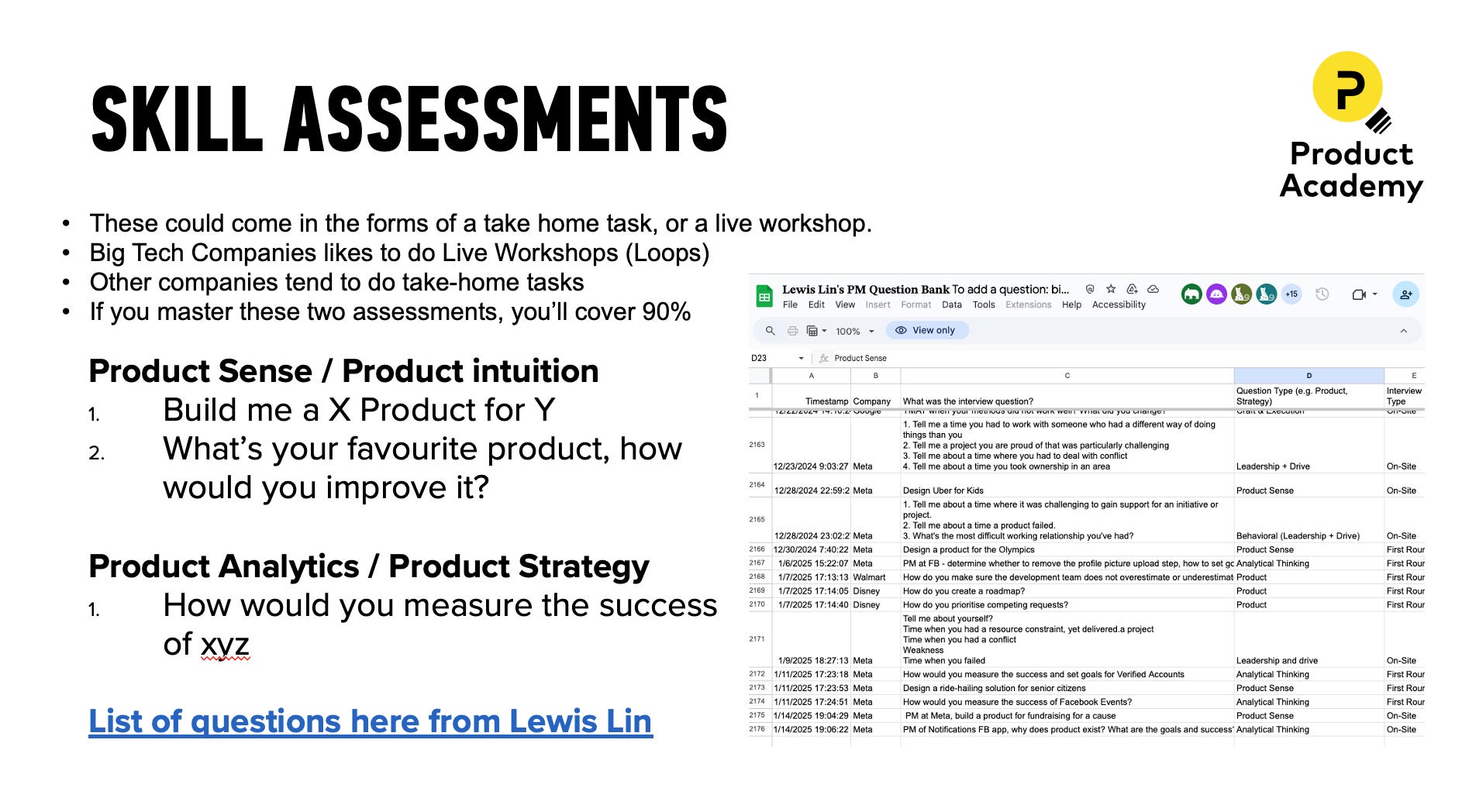
Interview practice is a series of posts. In the meantime, here are some resources I’ve personally found helpful:
-
Lewis Lin’s Book and Community: Great for general Product Management interview preparation. Lewis’s framework is helpful, but adapt it to your style.
-
IGotAnOffer: Great for Big Tech interview preps. Mark Rose’s interview videos are particularly helpful. He coached me before, and I’ve learned a lot from him.
-
Exponent: Useful for understanding the overall interview process and accessing a question bank.
-
Meta / Amazon / Atlassian also have great Product Management candidate guides that clearly outline their expectations for Product Managers. It’s a great place to start.
Most product interviews follow Big Tech’s process, so learning how they hire Product Managers will prepare you well.
I host fortnightly Lunch and Learn sessions for aspiring PMs because I know this journey can feel lonely.
Let’s navigate together. Join me here at the Product Academy Meetup.
Final Words: Don’t Wait Years Before You Start Your First Hour
Breaking into Product Management is tough, especially with fewer roles and intense competition from senior candidates.
But this market also creates opportunities—as seniors flock to the safety of big companies, startups, and scale-ups struggling to hire PMs. This is your sweet spot.
Focus on learning, gaining experience, and securing referrals. Prioritize title and skill growth over salary. The key is to think differently and use market dynamics to your advantage. Yes, competition is high, but winners focus on their goals, not the crowd.
The first step starts today, and I’m here to help. ❤️




Responses